




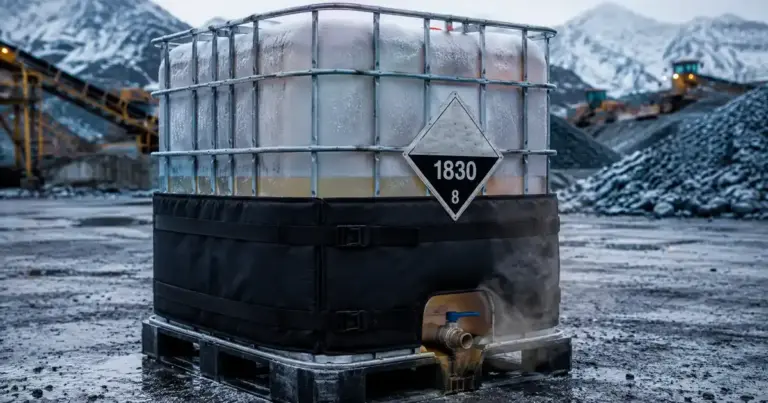
Cold weather doesn’t just slow down equipment on a mine site — it can affect the reagents that make the process work at all. Sulfuric acid, one of the most widely used chemicals in mining (particularly in copper leaching), is a case in point: it’s often assumed that a more concentrated acid is more resistant to cold, the same way stronger alcohol resists freezing better than a diluted mix. With sulfuric acid, that assumption doesn’t hold.
In short: sulfuric acid’s freezing behavior is not a straight line against concentration. Rather than getting steadily more resistant to cold as it gets purer, industrial data shows that some of the most common high-purity concentrations used in industry are actually more prone to solidifying than slightly less concentrated ones — a fact confirmed by acid producers themselves, not just lab theory.
Below, we break down why this happens, what it means for reagent storage and handling in cold or high-altitude mining operations, and why controlled, uniform heating — not just “more heat” — is the right way to manage it.
Cold Weather Is a Real Operational Risk in Mining, Not Just an Inconvenience
Mining operations in cold or high-altitude regions face a well-documented set of cold-weather challenges: diesel fuel can gel, hydraulic fluids thicken, batteries lose charge, and metal components can become brittle in sustained low temperatures. Some operations see temperature swings of over 100°C between summer and winter extremes, which puts constant stress on fixed infrastructure, not just mobile equipment.
Reagents used in ore processing are part of that same exposure — and because they’re chemically active (not just mechanical parts), the risks of mishandling them in cold conditions go beyond simple downtime.
The Sulfuric Acid Paradox
This is the detail most operations don’t expect: according to sulfuric acid industry technical documentation, heating and insulation are generally required for 96%, 98%, and 99% acid, while 93% acid — one of the most common industrial concentrations — rarely requires either.
That’s a counterintuitive result. Sulfuric acid doesn’t follow the pattern most liquids do, where higher purity means a lower freezing point. Instead, its freezing behavior follows a complex phase diagram, with different concentrations forming different crystalline hydrates at different temperatures — meaning some high-purity concentrations are, in practice, more vulnerable to cold than others that are slightly more dilute. Rail tank cars used for transporting 93% acid typically don’t need insulation, while cars carrying 96–99% acid usually do, and are sometimes fitted with steam coils for winter use.
The practical takeaway: the specific concentration of acid in use determines its real cold-weather risk — and that has to be confirmed against the product’s own technical data sheet, not assumed from concentration alone.
Container Materials — Why This Matters for Storage
Sulfuric acid at or above roughly 93% concentration is generally compatible with carbon steel for storage tanks, tank cars, and other equipment at ambient temperatures — which is part of why steel drums and steel-based container systems are a standard format for handling and storing it in industrial and mining settings, particularly for the sub-1-metric-ton volumes typically handled in drums or IBC totes rather than bulk rail or marine shipments.
One detail worth flagging: heating this acid isn’t simply a matter of “the more heat, the better.” Corrosion rates for carbon steel in sulfuric acid generally increase with temperature across most concentrations — which means uncontrolled or excessive heating doesn’t just risk wasting energy, it can accelerate wear on the container itself. This is exactly why controlled, thermostat-regulated heating — warming only enough to stay above the acid’s specific freezing threshold, not further — matters more here than in less reactive liquids.
In practice, this is generally addressed with heating systems designed for drums and IBC totes that apply steady, even warmth with precise temperature control, rather than uncontrolled or localized heat sources.
Beyond the Acid: Cold Also Threatens Safety Equipment
This is a detail that’s easy to overlook: cold weather doesn’t just threaten the reagent, it threatens the safety systems built around it. Industry safety guidance requires that emergency safety showers and eyewash stations near acid handling areas be “weatherized” — specifically freeze-protected — and supplied with tempered water in a controlled range, since a victim may need to stay under the shower for a full 15 minutes after exposure.
In a cold-climate or high-altitude mine site, a frozen emergency shower isn’t a minor maintenance issue — it’s a safety system failure at the exact moment it would be needed most. It’s a good reminder that cold-weather planning around reactive chemicals needs to cover the surrounding safety infrastructure, not just the product itself.
Best Practices for Cold-Climate Reagent Storage
- Check the specific concentration’s technical data sheet rather than assuming higher purity means better cold resistance — with sulfuric acid, that assumption can be wrong.
- Use controlled, thermostat-regulated heating, not open flame or uncontrolled heat sources — both to protect the reagent and to avoid accelerating container corrosion.
- Confirm container material compatibility for the specific acid concentration and temperature range in use before applying any heating solution.
- Extend cold-weather planning to safety infrastructure — emergency showers, eyewash stations, and associated plumbing need freeze protection too.
- Don’t rely on general internet reference tables for exact freezing points — sulfuric acid’s freezing behavior is concentration-specific and non-linear; verify with the supplier’s own technical documentation.
Frequently Asked Questions
Does a more concentrated acid always resist cold better? Not with sulfuric acid. Industry technical data shows that some high-purity concentrations (96–99%) generally require heating and insulation in cold conditions, while a slightly less concentrated, commonly used grade (93%) generally doesn’t — the opposite of what most people would assume.
Why doesn’t sulfuric acid follow a simple freezing-point pattern? Its freezing behavior follows a complex phase diagram rather than a straight line — different concentrations form different crystalline hydrates at different temperatures, so freezing risk doesn’t decrease steadily as concentration increases.
What container materials are used for sulfuric acid in mining? Carbon steel is generally suitable for storage and handling at concentrations around 93% and above at ambient temperatures, which is why steel drums and steel-based IBC systems are common for the sub-1-metric-ton volumes typical of on-site reagent handling.
Is more heating always better for cold-affected sulfuric acid? No. Corrosion rates for steel in sulfuric acid generally rise with temperature, so uncontrolled or excessive heating can accelerate container wear. Controlled, thermostat-based heating that stays just above the acid’s freezing threshold is the safer approach.
What other cold-weather risks are relevant to reagent handling sites? Safety infrastructure like emergency showers and eyewash stations also needs freeze protection — a frozen safety shower at a chemical handling site is a real safety gap, not just an equipment issue.